Investment Strategy
Asset Allocation - Diversify Your Investments
Learn how optimal asset allocation across different asset classes can help you manage risk, optimize returns, and achieve your financial goals through strategic diversification.
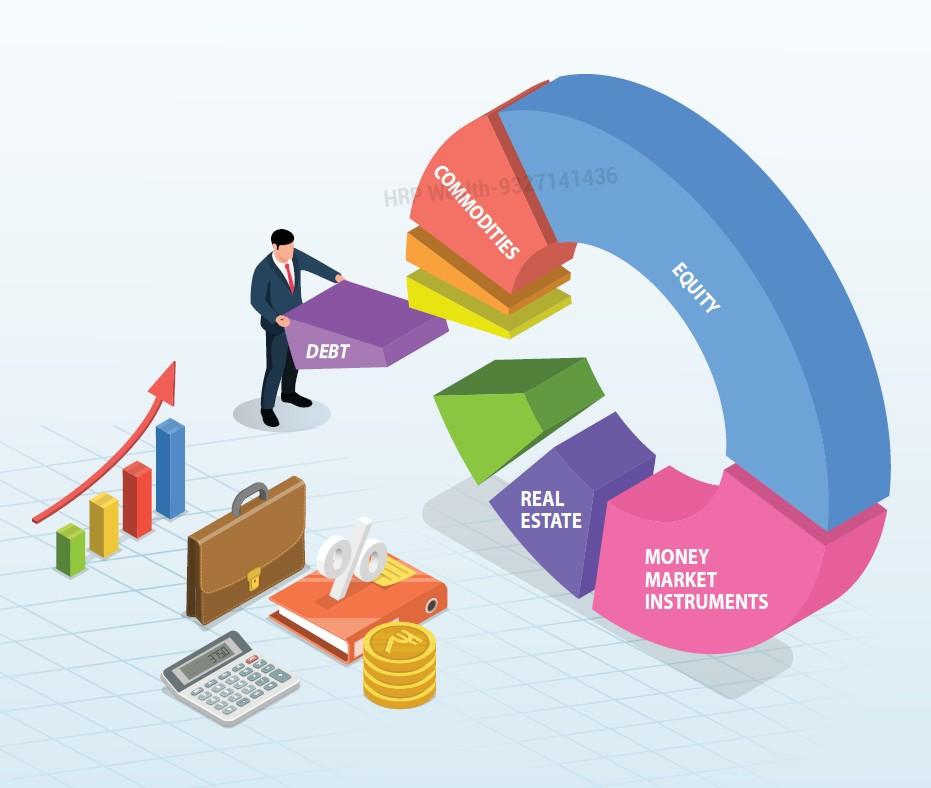
Diversify Across Asset Classes

Manage Risk Effectively

94% Performance from Allocation
Optimize Returns with Balance
What is Asset Allocation?
Asset allocation refers to the procedure of allocating capital to different asset classes, such as equity and debt, based on risk profile, investment horizon, and expected returns.
For optimal asset allocation, investors should analyse their risk tolerance and risk appetite, through which they can create a risk profile. Based on the risk profile, they can make the right asset allocation decisions.
Just like a pizza is divided into slices, your investment portfolio should be divided across different asset classes for optimal results.
Why is Asset Allocation Important?
Risk Management
Through optimal asset allocation, investors can manage their risk by investing proportionally in their preferred asset class based on their risk tolerance.
Diversification
Spreading investments across asset classes reduces the concentration risk on a single asset class, providing better portfolio stability.
Optimizing Returns
Different asset classes perform differently under various market conditions. A well-allocated portfolio can take advantage of growth opportunities while mitigating risk.
Drivers of Portfolio Performance
A research paper by Brinson, Hood, and Beebower indicates that 94% of the portfolio performance is driven by asset allocation!
Asset Allocation
94.0%
Scheme/Stock Selection
4.0%
Market Timing
2.0%
Source - Determinants of Portfolio Performance, Brinson, Hood & Beebower, Financial Analyst Journal (July/August 1986)
Hence, optimal asset allocation is of utmost importance for generating good returns.
Types of Asset Classes
EQUITY
Just like a pizza is divided into slices, a company's capital is also divided into slices. This part of the capital is referred to as equity capital and has the potential for high growth corresponding with risk. Equity mutual funds invest in well-established and high growth potential companies.
DEBT
Debt refers to the part of the capital that is made up of fixed income and bonds that needs to be repaid in a specific period of time with a certain amount of interest. These investments are generally less volatile but their returns are limited to the interest amount.
Other asset classes include Real Estate, Money Market Instruments, Gold, and Silver.
Comparison of Asset Classes
When we compare different asset classes like gold, silver, bank deposits, company deposits, and Sensex, we can clearly see that Sensex has outperformed over the long term.
Actual Return vs Real Return (After Inflation)
Source: RBI - Inflation data as on Mar 2024 | RBI - Gold & Silver data as on Mar 2024 | RBI - Bank Deposits & Co. Deposits data as on Sep 2023 | Sensex data as on Mar 2024 - Source BSE
Equity mutual funds invest in well-established and high growth potential companies. Hence, investing through equity mutual funds can help you generate superior wealth in the long term.
Factors Affecting Asset Allocation
Tax Consideration
Tax implications of different asset classes should be considered while making allocation decisions.
Investment Horizon
Your time horizon for investment goals determines the appropriate asset mix for your portfolio.
Financial Needs
Your specific financial goals and requirements influence how you allocate assets across different classes.
Financial Situation
Your current financial position, income, and expenses play a crucial role in determining asset allocation.
Age and Life Stage
Your age and life stage determine your risk capacity and investment timeline, affecting asset allocation.
Risk Profile
Your risk tolerance and risk appetite are fundamental in determining the right mix of equity and debt.
Mistakes to Avoid During Asset Allocation
Not Reviewing and Rebalancing
Once you invest with your desired asset allocation, it is important to review your portfolio regularly. Market conditions can change over time, due to which the allocation of your investment also changes. Hence, reviewing your portfolio can help you determine whether your portfolio is in line with your desired asset allocation or any adjustments are required.
Emotional Biases
Investors often make decisions based on their emotions such as fear and greed. Such irrational decisions can lead to improper asset allocation and losses. Thus, investors should keep their emotions in control while determining their asset allocation.
Ready to Optimize Your Asset Allocation?
Choosing the optimal asset allocation strategy based on your financial needs and risk profile may seem like a daunting task. Seek guidance from a mutual fund distributor who can help you make the right asset allocation decision.
Disclaimer
The information contained herein does not constitute, and should not be construed as, investment advice or a recommendation to buy, sell, or otherwise transact in any security or investment product or an invitation, offer or solicitation to engage in any investment activity. It is strongly recommended that you seek professional investment advice before taking any investment decision.
Any investment decision that you take should be based on an assessment of your risks in consultation with your investment adviser. To the extent that any information is regarding the past performance of securities or investment products, please note such information is not a reliable indicator of future performance and should not be relied upon as a basis for an investment decision.
Past performance does not guarantee future performance and the value of investments and the income from them can fall as well as rise. No investment strategy is without risk and markets influence investment performance. Investment markets and conditions can change rapidly, and investors may not get back the amount originally invested and may lose all of their investment.
Mutual fund investments are subject to market risks, read all scheme related documents carefully before investing.
HRP WEALTH | 9327141436 | HRPWEALTH@GMAIL.COM | AMFI REGISTERED MUTUAL FUND DISTRIBUTOR (ARN-342284)